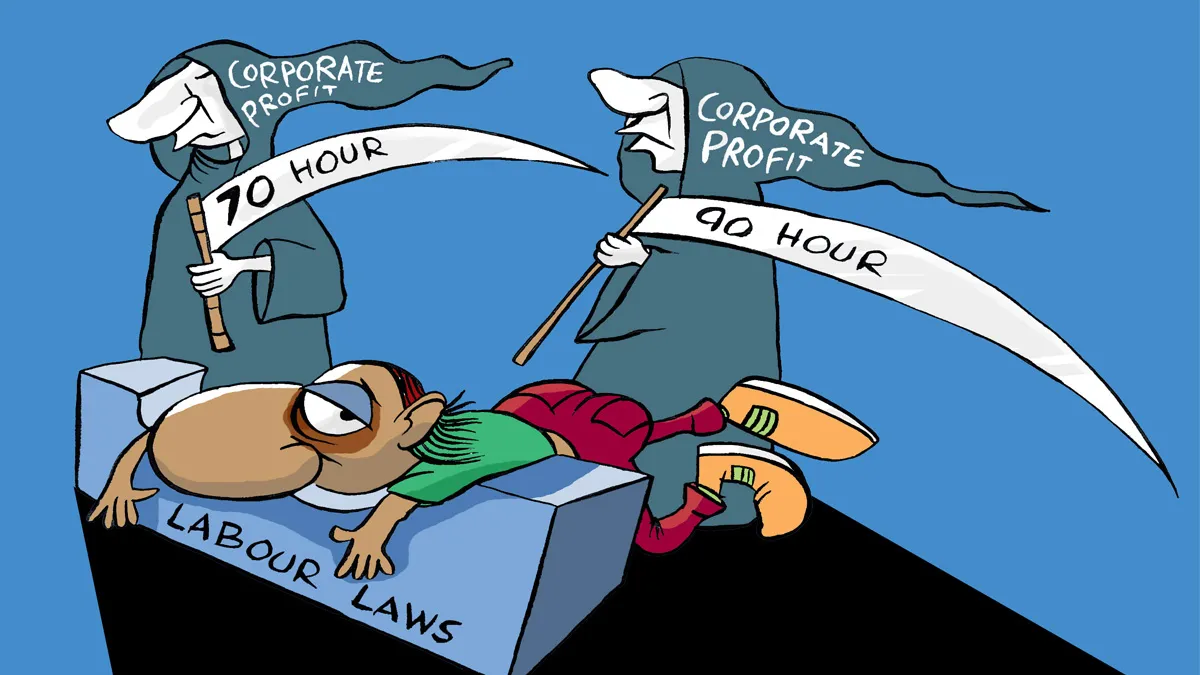
The Indian government is pressing all states and Union Territories (UTs) to publish their rules under the four new labour Codes by October 31, aiming to fully operationalise the new labour law framework. This move is crucial as labour falls under the concurrent list, requiring state-level rule-making for effective implementation.

India's urban unemployment rate for individuals aged 15 and above marginally increased to 6.7 per cent in April-June, while rural unemployment rose to 4.8 per cent, according to the latest Periodic Labour Force Survey (PLFS). This rise in unemployment coincides with a notable decline in the overall labour force participation rate (LFPR) to a five-quarter low of 54.6 per cent.

US Vice President J D Vance has labelled the H-1B visa programme as "completely broken" and expressed support for its total abolition. He argues that corporations exploit the system to replace American workers with cheaper international staff, rather than bringing in elite talent. Vance also defended the controversial $100,000 levy on certain H-1B petitions, viewing it as a deterrent against cost-cutting exploitation.

'While the population remains relatively young, its age structure is beginning to shift, setting the stage for a much older population later this century.'

India has secured a spot among the top 10 leading emerging-market performers in artificial intelligence (AI) readiness, with private investment in AI more than tripling to USD 4.1 billion in 2025, according to a new World Bank report.

A section of industry may need to begin compliance immediately, even as most states are yet to notify their rules.

PhonePe has announced a significant expansion plan to deepen digital payment infrastructure across India's towns and villages. This initiative includes hiring over 20,000 sales personnel and deploying more than 50 lakh payment devices, with a strong focus on rural areas, aiming to bring small merchants into the formal financial ecosystem.
The India-Oman free trade agreement, operationalised on June 1, is set to create significant export opportunities for India's labour-intensive and value-added sectors, including textiles, gems and jewellery, and marine products, while also strengthening energy security.

Tata Sons Chairman N Chandrasekaran views the group's investment in semiconductors not as a short-term financial play, but as a critical long-term commitment to India's growth and self-reliance in a sector vital for domestic consumption and global supply chains.

The Union Cabinet has approved a significant increase in the mandatory EPFO wage ceiling from Rs 15,000 to Rs 25,000 per month, a move expected to bring over 51 lakh additional employees under mandatory social security coverage.

The Indian Army has launched 'Bharat Rice', a superior-quality rice for defence forces, aimed at improving ration quality and logistics. This initiative, spearheaded by the Directorate General of Supplies and Transport, involves direct supply to Army Supply Depots, including remote areas, and an MoU with FCI for infrastructure utilisation during contingencies. Defence Minister Rajnath Singh highlighted its significance for soldier welfare, operational readiness, and national security, emphasising logistics as combat power.
The US Trade Representative has proposed an additional 12.5 per cent duty on goods from 54 countries, including India, citing their failure to prohibit the import of goods produced with forced labour. India has denied the allegations and called for the matter to be resolved through bilateral trade negotiations.

The Maharashtra government has declared 265 out of 358 talukas as drought-affected, covering 74% of the state, due to significant rainfall deficit. This declaration activates 'Trigger-1' of the state's drought management framework, leading to the announcement of various relief measures for farmers and residents, including loan restructuring, revenue concessions, and provisions for water and fodder.

Prime Minister Narendra Modi and US President Donald Trump held a telephone conversation to review progress in bilateral ties, covering trade, defence, and energy, against the backdrop of heightened trade friction due to the 'Lindsey O. Graham Sanctioning Russia and Iran Act of 2026'.

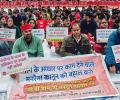
Farmers under the Samyukta Kisan Morcha have initiated a week-long protest at the Chandigarh-Mohali border, demanding a minimum support price (MSP) based on the C2 plus 50 per cent formula, debt waivers, and opposing the proposed India-US trade deal, Electricity Amendment Bill, and Seed Bill. They also raised concerns about water depletion and sought resolutions based on riparian principles.

Economists highlight that resolving domestic policy bottlenecks, particularly through land reforms and improving the ease of doing business, will be critical for Prime Minister Narendra Modi's 'next-generation reforms' and India's economic transformation towards its 'Viksit Bharat' vision for 2047.

'Tariff action relating to the excess-capacity investigation will be even more susceptible to judicial overturn.'

Despite near gender parity in basic bank account ownership, women in India remain significantly underrepresented in the growing platform economy due to gaps in digital financial capability and access to credit, according to a joint report by the International Labour Organization and National Council of Applied Economic Research.

India's largest retirement fund manager, the Employees' Provident Fund Organisation (EPFO), is enhancing its investment governance and fund management practices, following the Reserve Bank of India's recommendations.

India's Code on Wages mandates strict payout deadlines, two-day full and final settlements, universal wage coverage and capped deductions to safeguard employees and enhance payroll transparency nationwide.

India is waiting for assurance from the US on comparative advantage over other economies under the deal.

In many ways, 17th century India occupied a position in the global economy comparable to that of the United States today. Just as millions of people now look towards America because of its economic opportunities, merchants, adventurers and trading companies once looked towards India.

New Delhi must look for formal, institutional statements issued directly from Washington rather than rely on casual pronouncements meant for local audiences, notes Ambassador Rajasekhar.
The Indian government has notified final rules under four labour codes, potentially enabling a four-day workweek in certain sectors by capping weekly working hours at 48 while allowing daily flexibility. This move also introduces significant changes to wage fixation, compliance obligations, and social security norms.

A new report by ADP reveals that one in two Indian companies plan to adopt AI-powered payroll systems within the next 12 months, driven by the need for automation in workforce management, compliance, and compensation decisions. However, firms are increasingly cautious about data protection risks, especially with the implementation of the Digital Personal Data Protection (DPDP) Act, 2023.

'It will increase the contribution to gratuity, which is something the employer has to give.'

The Delhi government is establishing a multidisciplinary committee to develop a regulatory framework for coaching institutes. This initiative follows recent tragedies, including the Saket building collapse and the Old Rajendra Nagar coaching centre incident, and aims to address issues like fee structures, student safety, infrastructure, and grievance redressal.

The United States and India are on the verge of finalising a landmark bilateral trade deal, aiming to boost trade to USD 500 billion by 2030, according to US Deputy Assistant Secretary of State Bethany Poulos Morrison. The agreement seeks to open India's 1.4 billion-strong market to American goods on reciprocal terms, with ongoing high-level discussions to recalibrate the pact after recent changes in US tariff policy.
India and the United States have reviewed progress on a proposed interim bilateral trade agreement, discussing market access, digital trade, and non-tariff barriers, as they race to finalise a deal before a temporary 10 per cent US tariff regime expires on July 24.

For MSMEs the transition could mean higher wage bills and tougher compliance -- unless strong handholding follows reports Auhona Mukherjee.

The 'Return to Play Post-Pregnancy Guidelines' for female cricketers, outline a six 'R's framework: Ready, Review, Restore, Recondition, Return and Refine.
The Centre has notified draft rules for the Viksit Bharat - Guarantee for Rozgar and Ajeevika Mission (Gramin) Act, 2025, outlining the framework for the new rural employment programme replacing MGNREGA. The draft rules are open for public feedback until June 21, 2026.

IT services major LTM is set to introduce a new pricing framework, 'Blueverse Credit', in the first quarter of FY27, aiming to align monetisation with the growing adoption of agentic artificial intelligence.

The Indian government has announced the replacement of the Mahatma Gandhi National Rural Employment Guarantee Act (MGNREGA) with the Viksit Bharat Guarantee for Rozgar and Ajeevika Mission (Gramin), or VB-G RAM G Act, 2025, effective July 1. The new scheme aims to expand guaranteed wage employment and link it more closely with infrastructure development and climate resilience, but faces concerns from opposition parties and labour rights activists.

SIS Ltd, a security and facility management services provider, aims to cross Rs 20,000 crore in revenue by FY27, driven by strong double-digit growth, expansion of its service network, and a simplified regulatory framework under new labour codes, said its Group Managing Director Rituraj Sinha.

Male central government employees are entitled to 15 days under service rules and provisions in the private sector depends on the company's policy.

'They talked bad about our leaders. They said India was a dead economy. They were not sensitive to the Indian psyche.'

Infosys on Wednesday reported a one-time exceptional hit of Rs 1,289 crore on account of the impact of the implementation of new labour codes, as India's second-largest IT services firm announced its December quarter earnings.

Notwithstanding the economic complementarities and the host of agreements for deepening economic relation on a host of areas, both sides share common viewpoints on the foreign policy domain and seek common grounds to serve as a counterweight to China, notes Dr Rajaram Panda.

Not a single retail outlet ran dry. Every household that wanted a cylinder got one. India faced neither a 1991 moment nor a 2013 one. Macroeconomic stability held. This was not an accident, and it was not luck alone. It was the work of a government that chose to act as it had during the pandemic -- deliberately and gradually, building one measure upon another rather than reaching for a single dramatic lever, explains V Anantha Nageswaran, chief economic advisor to the Government of India.
